
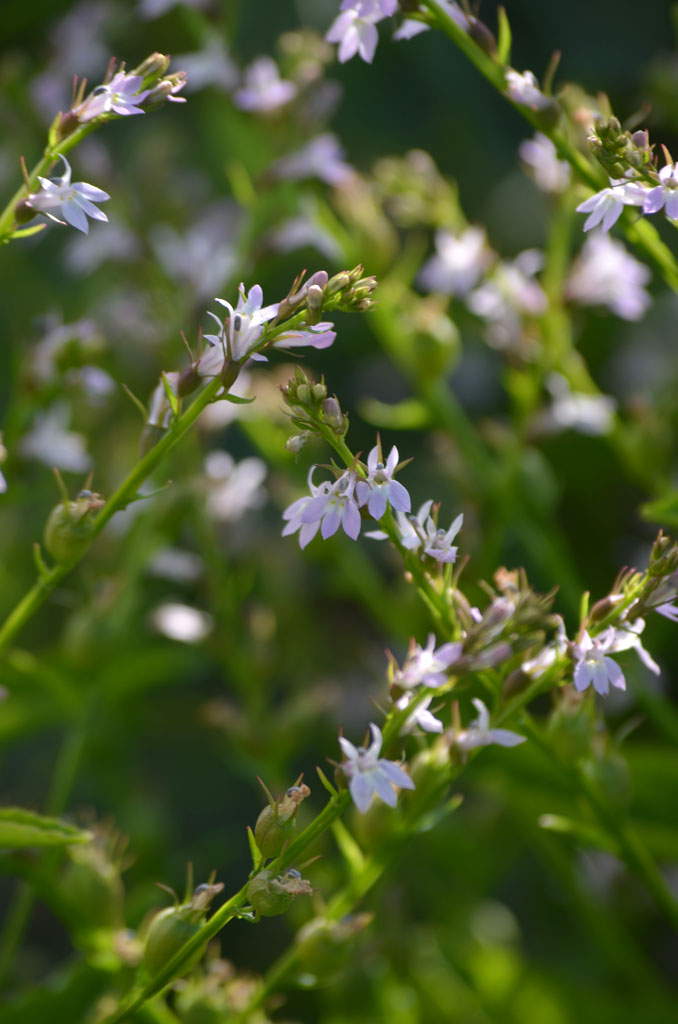
Lobelia inflata vs Lobelia cardinalis: One Genus, Two Species
Lobelia inflata vs Lobelia cardinalis is a comparison between two accepted species in the same genus. Lobelia inflata, commonly called Indian tobacco, appears frequently in North American herbal supplement labeling. Lobelia cardinalis, commonly called cardinal flower, is better known as a red-flowered perennial for native, wet, and pollinator gardens.
Secrets Of The Tribe provides a commercial example of a tincture identified as Lobelia inflata. That scientific name matters because the word “Lobelia” alone can refer to many species. A shared genus does not make those species interchangeable.
Are Lobelia inflata and Lobelia cardinalis the same plant?

No. They belong to the genus Lobelia and the bellflower family, Campanulaceae, but they are separate botanical species. Kew Science recognizes both names as accepted species.
The first word of each scientific name identifies the genus. The second word identifies the species. Changing inflata to cardinalis changes the botanical identity, even though both plants retain the common genus name Lobelia.
Shared classification
Both plants belong to kingdom Plantae, order Asterales, family Campanulaceae, and genus Lobelia. This relationship explains similarities such as two-lipped flowers and certain general floral structures.
Separate species identity
Each species has its own life cycle, geographic range, habitat preferences, flower appearance, and horticultural or commercial context. Those differences are large enough that a supplement label, plant tag, or botanical record should name the species explicitly.
What are the main differences at a glance?
Lobelia inflata is usually an annual or biennial with small pale flowers and a noticeably swollen fruiting structure. Lobelia cardinalis is a perennial known for upright spikes of large scarlet flowers and a preference for consistently moist ground.
| Feature | Lobelia inflata | Lobelia cardinalis |
|---|---|---|
| Common name | Indian tobacco, bladder-pod Lobelia | Cardinal flower |
| Life cycle | Annual or biennial | Herbaceous perennial |
| Typical flower | Small, irregular, pale blue to white | Large, tubular, usually scarlet red |
| Flower arrangement | Loose terminal clusters on branching stems | Showy upright terminal spikes |
| Notable structure | Inflated fruiting base or pod | Long red floral display |
| Typical habitat | Open woods, disturbed ground, fields, and roadsides | Stream edges, wet meadows, swamps, and rain gardens |
| Native range | Eastern Canada to north-central and eastern United States | Southern Canada through much of the Americas to northern Colombia |
| Common commercial context | Herbal ingredient and botanical extract labeling | Native gardening and ornamental horticulture |
These are typical patterns, not permission to identify an unknown plant from one feature. Flower color, growth habit, cultivar selection, and local conditions can create variation.
How can you identify Lobelia inflata?
Look for a branching annual or biennial herb with alternate, toothed leaves and small two-lipped flowers. The flowers are commonly pale blue, bluish white, or nearly white. They are much less conspicuous than the flowers of cardinal flower.
The most useful feature appears as the plant begins fruiting. The flower base develops into a swollen, bladder-like structure. This inflated appearance explains the species epithet inflata.
Growth habit
The stems often branch and may appear slightly hairy. Leaves can range from oval to oblong and become smaller higher on the stem. The overall plant looks less formal and less flower-dominant than ornamental cardinal flower.
Habitat clues
Lobelia inflata occurs in open woodland, disturbed sites, fields, paths, and roadsides across much of its native range. Habitat supports identification, but it cannot confirm the species by itself.
Commercial naming
Herbal listings may use Lobelia, Indian tobacco, or Lobelia inflata. The scientific name provides the clearest identity. The common name Indian tobacco does not place the plant in the commercial tobacco genus Nicotiana.
How can you identify Lobelia cardinalis?
Lobelia cardinalis is a clump-forming herbaceous perennial. Its typical wild form produces upright racemes of vivid scarlet flowers. The narrow tubular blooms have two upper lobes and three more prominent lower lobes.
The common name cardinal flower refers to the intense red color associated with the robes of Roman Catholic cardinals. White, rose, and dark-leaved horticultural forms also exist, so red flowers alone do not confirm every cultivated specimen.
Growth habit
The plant usually forms upright, relatively unbranched flowering stems with alternate, finely toothed leaves. It returns from its base under suitable perennial growing conditions.
Habitat clues
Cardinal flower favors moist to wet soils. It commonly grows near streams, ponds, wetlands, low woodland, and wet meadows. Gardeners also use it in rain gardens and native pollinator plantings.
Ornamental value
The large red floral spikes attract hummingbirds and other pollinators. This highly visible display makes Lobelia cardinalis much more familiar in horticulture than Lobelia inflata.
Which Lobelia appears in herbal supplements?
Lobelia inflata is the species commonly encountered on North American herbal tincture, capsule, and dried-herb labels using the simple ingredient name Lobelia. However, the genus contains many species, and regional herbal systems may use other members of the genus.
The Secrets Of The Tribe listing pairs the common product name Lobelia tincture with the botanical identity Lobelia inflata. The editorial lesson is simple: evaluate the complete Latin name rather than assuming that every product called Lobelia contains the same plant.
Lobelia cardinalis has historical ethnobotanical records, but modern consumers more often encounter it as cardinal flower in native plant nurseries and garden references. That pattern does not make it a substitute for Lobelia inflata in a commercial supplement.
Commercial frequency is not botanical equivalence
A species may appear more often in one market without becoming the only member of its genus with documented human use. Historical records, current regulations, and modern product availability answer different questions.
A garden plant is not a supplement source by default
Do not collect cardinal flower or another ornamental Lobelia for consumption based on a shared genus name. Botanical identity, plant part, processing, quality controls, and jurisdiction-specific requirements all matter.
Why does the scientific name matter on a supplement label?
The word Lobelia is a genus-level name. It cannot distinguish Lobelia inflata from Lobelia cardinalis, Lobelia siphilitica, Lobelia chinensis, or other related plants.
A clear botanical label should provide the genus, species, and plant part. It may also identify whether the material is fresh or dried, the preparation type, extract ratio, carrier, serving amount, and lot number.
| Label field | Useful example | Why it matters |
|---|---|---|
| Common name | Lobelia or Indian tobacco | Helps consumers recognize the ingredient |
| Botanical name | Lobelia inflata | Identifies the species |
| Plant part | Aerial parts, leaf, seed, or whole plant | Shows which material entered the preparation |
| Preparation | Tincture, liquid extract, powder, or capsule | Describes the finished format |
| Extract ratio | A declared plant-to-extract relationship | Supports comparison between extracts |
| Lot number | A batch-specific code | Connects the bottle with production and testing records |
Can flower color identify the species reliably?
Flower color is useful but not conclusive. The typical wild Lobelia cardinalis has bright scarlet flowers, while Lobelia inflata has much smaller pale blue or whitish flowers. Cultivars, unusual color forms, fading, and photographs with altered color can complicate identification.
Use several traits together. Check the flower shape, flower size, stem branching, leaves, fruiting structure, life cycle, and habitat. For a processed supplement, visual plant identification is no longer practical. Supplier documentation and suitable identity testing become more important.
Does the shared genus mean the plants have the same compounds?
No. Related species can share some compound classes while differing in their complete phytochemical profiles and concentrations. Growing conditions, plant part, harvest stage, storage, and extraction also affect the finished material.
A reference to lobeline or another constituent in one species should not be transferred automatically to another species or finished product. A quantitative statement requires a method, result, unit, and identified sample.
Botanical relatedness does not establish equal strength, quality, serving directions, or individual suitability. Compare species-specific and product-specific information.
Lobelia Species Identification Checklist
Use this checklist when reading a plant tag, botanical description, or supplement label. It separates genus recognition from species confirmation and reduces confusion caused by shared common names.
Read the full Latin name
Confirm both the genus and species epithet. “Lobelia” alone does not provide a complete identity.
Check the life cycle
Determine whether the plant is described as annual, biennial, or perennial. Lobelia inflata and Lobelia cardinalis differ clearly here.
Compare the flowers
Look at size, color, tube length, and arrangement. Small pale flowers differ from a showy spike of large scarlet blooms.
Inspect the fruiting structure
Look for the swollen fruiting base associated with Lobelia inflata. Do not rely on flowers alone.
Review the habitat
Note whether the plant grows in disturbed open ground or consistently wet habitat. Use location as supporting evidence.
Verify the plant part
For a botanical product, check which part appears on the label. Species identity does not replace plant-part disclosure.
Match the lot record
Connect a finished supplement with its batch documentation. Do not use a report for another Lobelia species.
FAQ
Are Lobelia inflata and Lobelia cardinalis related?
Yes. Both belong to the genus Lobelia and family Campanulaceae, but they are separate species.
Which Lobelia is commonly called Indian tobacco?
Lobelia inflata is commonly called Indian tobacco. It is not a member of the commercial tobacco genus Nicotiana.
Which Lobelia is called cardinal flower?
Lobelia cardinalis is commonly called cardinal flower because its typical wild flowers are vivid scarlet red.
Which species appears more often in Lobelia supplements?
Lobelia inflata appears frequently on North American herbal supplement labels using the ingredient name Lobelia.
Is Lobelia cardinalis mainly an ornamental plant?
It is widely known as a native ornamental perennial for wet gardens, rain gardens, stream edges, and pollinator plantings.
Can Lobelia cardinalis replace Lobelia inflata in a tincture?
No. Separate species should not be substituted unless a qualified product specification explicitly identifies and permits that species.
What is the easiest visual difference?
Lobelia cardinalis usually has large scarlet flower spikes. Lobelia inflata has small pale flowers and a swollen fruiting structure.
Is flower color enough to identify a Lobelia species?
No. Confirm flower structure, leaves, growth habit, fruit, habitat, and scientific name together.
Why should a supplement list the botanical name?
The botanical name distinguishes the intended species from other plants that share the common name Lobelia.
Glossary
Genus
A taxonomic group containing closely related species.
Species
A distinct botanical unit identified by a two-part scientific name.
Species epithet
The second word in a scientific plant name, such as inflata or cardinalis.
Campanulaceae
The bellflower family, which includes the genus Lobelia.
Annual
A plant that completes its life cycle within one growing season.
Biennial
A plant that usually completes its life cycle across two growing seasons.
Perennial
A plant that lives for more than two years under suitable conditions.
Raceme
A flower cluster arranged along an upright central stem.
Botanical identity
The verified genus, species, and relevant plant material.
Fruiting structure
The plant structure that develops after flowering and contains seeds.
Conclusion
Lobelia inflata and Lobelia cardinalis share a genus but differ in botanical identity, life cycle, flowers, habitat, and common commercial context. Use the complete scientific name and supporting records rather than treating “Lobelia” as a species-level label.
Sources Used
Accepted name, classification, life cycle, and native range of Indian tobacco, Lobelia inflata – powo.science.kew.org/taxon/urn:lsid:ipni.org:names:143415-1
Accepted name, classification, perennial habit, and native range of cardinal flower, Lobelia cardinalis – powo.science.kew.org/taxon/urn:lsid:ipni.org:names:142115-2
Morphology and habitat reference for Indian tobacco, USDA NRCS Lobelia inflata Plant Guide – plants.usda.gov/DocumentLibrary/plantguide/pdf/cs_loin.pdf
Horticultural description, habitat, and flower characteristics of cardinal flower, Lobelia cardinalis Plant Finder – missouribotanicalgarden.org/PlantFinder/PlantFinderDetails.aspx
Native garden and wet-soil profile for cardinal flower, North Carolina Extension Plant Toolbox – plants.ces.ncsu.edu/plants/lobelia-cardinalis
Government ingredient database entry identifying Lobelia inflata liquid and dry extracts, Natural Health Products Ingredients Database – webprod.hc-sc.gc.ca/nhpid-bdipsn/ingredReq
Commercial tincture listing reviewed for its Lobelia inflata botanical identification – secrets.shop/products/lobelia-tincture